Thursday, 17 September 2015

A Copyright Casualty — Part III


In the final part of this series about William Ashbee, I want to round off the story of his historic copyright case with some contextual details, including the location of his offices, the directory itself, some court transcripts, and his youngest son (also William).

The Directory

The Merchants' and Manufacturers' Pocket Directory of London is a rare publication by virtue of the associated copyright case. In fact, I doubted whether any copies might have survived. WorldCat.org lists just one microfilm copy in the Duke University Libraries, North Carolina. However, that entry also includes a credit to the British Library Reference Division, Reprographic Section. I therefore approached their Rare Books and Music Reference Service and they confirmed that they do actually have a physical edition.[1] Although I have requested a full copy, they kindly provided me with the following images of the leading pages, free of charge, in order to display here.

Merchants' and Manufacturers' Pocket Directory of London, preface
Figure 1 - Merchants' and Manufacturers' Pocket Directory of London, preface; © The British Library Board, P.P.2490.R; Displayed by permission of the British Library.

Merchants' 

and Manufacturers' Pocket Directory of London, title page
Figure 2 - Merchants' and Manufacturers' Pocket Directory of London, title page; © The British Library Board, P.P.2490.R; Displayed by permission of the British Library.

Merchants' and Manufacturers' Pocket Directory of London, contents
Figure 3 - Merchants' and Manufacturers' Pocket Directory of London, contents; © The British Library Board, P.P.2490.R; Displayed by permission of the British Library.

The preface was written in December 1867, although the publication occurred some time during 1868. The title page shows that Ashbee & Co. were also agents for publishers in New York and in Germany; clearly they were looking to become as successful as the many other publishers of directories from that period.

Their Offices

The directory’s title page also shows that their first office was 190 Gray’s Inn Road, London, and that tallies with the information presented in Part I of this series. Google Maps shows that this address still exists, although it was a café at the time of writing.

Figure 4 - Gray's Inn Road, London. Google street view, April 2015.

At some point after this edition was printed, they moved their offices to 32 Bouverie Street, off Fleet Street, and that is where they were when the bill was filed. I searched in vein to find an image of that street from the 19th Century. Much of it has been redeveloped but it was host to several publishers and printers at the time, including the offices of the Daily News newspaper, established 21 Jan 1846, and famous for its steadfast coverage of the American Civil War when no others saw the global significance of it. The first editor of that newspaper was no less than Charles Dickens, although his position only lasted about three weeks.[2]

In order to locate where number 32 was, I consulted a directory from 1882, and the following is a transcript of that street, running south from Fleet Street, down the west side to Tudor Street, and then back up the east side.[3]

Bouverie st. 62 Fleet st. (E.C.) (CITY) MAP M9.

... here is Pleydell street...
1 & 2 Mackey, Mackey & Co. wholesale druggists
3 Haddon John & Co. publishers
  Smith Henry, die sinker
  Bennett John, bkbndrs.’ tool cuttr
4 Appleton Alfred J. wood engraver
  Crane Hy. Jas. wood engraver
  Hughes Henry, printer
  MacGeorge Edward & Co. advertising agents
6 Swain Joseph, wood engraver
  Evison & Bridge, law stationers
7 Paterson, Sons & Garner, solictrs
8 to 10 Bradbury, Agnew & Co. prntrs
... here is Essex Street ...
11 International News Co. exporters
12 Watson, Sons & Room, solicitors
13 Butcher Webster, solicitor
  Hipsley John Hy. draughtsman
  Skelton Robert, engraver
14 Spackman Leonard, job master
15 Gale & Co. wholesale druggists

       OTHER SIDE
16 Burnell H. Hockey, F.S.A. archtct
17 Davies Charles Edward, printer
17½ Clayton & Co. printers
18 Miall Charles Septimus
  Gadsby John, publisher
... here is George Yard ...
19, 20 & 21 Daily News Newspaper Office
22 Hall Thomas & Co. silversmiths
  Everett Wm. Hy. advertising agt
23 Symmons & Sons, bookbinders
  Irons Clarke & Co. wood engravrs
  Atkins Alfd. H. companies' statnr
  Garmeson Miss Mary Ann, ladies' school
24 Wells Chs. T. engravers’ block ma
  Country Brewers' Gazette Office
  Dyer (The) Office
  Oil & Drug Journal Office
25 Hawksworth, Eyre & Co. Limited, silversmiths
  Delitsch Paul, die sinker
  Long Henry, draughtsman
  Phipps George B. stationer
  Pool Charles, advertising agent
26 Dupere John Wm. cigar merchnt
27, 28 & 29 Martin, Hall & Co. Limited, silversmiths,
  James Crossley, agent
  Crossley Jas. manufctrs.' agent
30 Sussex, Mrs. Mary Ann Jones
31 Dunn & CO. printing ink manfrs
32 Murby Thomas, publisher
33 Dane J. & Co. printing ink makrs
34 Williamson Peter William, engravers’ block maker
  Wileman William publisher

Number 32 was still host to Thomas Murby, the previous publisher that I identified in Part I, and so the premises must have been shared with him. Interestingly, number 30 was the official address of the huge The News of the World offices until the newspaper's closure in 2011, and must have engulfed anything remaining of number 32. The following maps help to put the directory details in perspective: London, 1:1056, 1893-1895 and London/TQ, 1:1250/1:2500, 1947-1964, but they do not identify no. 32 specifically. I can infer that it was across the road from Pleydell Street, and slightly lower down, but no more.

Whilst writing this up, I found the most incredible map of the street from 1886 that showed the exact building, and even some of the internal detail. This was part of a series of fire insurance maps produced by Charles E. Goal Ltd., and it confirmed that my estimate was spot-on.[4]

Transcriptions

While researching for this series of articles, I obtained copies of a number of documents from a file held by The National Archives of the UK (TNA).[5] These included affidavits and depositions by the plaintiff and others, and interrogatories for the case itself.

Earlier affidavits from both the defendant and the plaintiff were held in chancery files held offsite from TNA’s Kew location. These took longer to obtain and so weren’t in the first edition of this article. 

These have all been transcribed and attached to this blog for future use. 

Affidavit from William Ashbee, 6 May 1868, before George White.
.

C 31 2233 No 1300 William Ashbee 6 May 1868.txt


Affidavit from John Stuart Crosbie Morris, 20 May 1868, before Benham and Tindell.

C 31 2233 No 1411 John Stuart Crosbie Morris 20 

May 1868.txt


Affidavit from William Ashbee, 22 May 1868, before George White.

C 31 2233 No 1447 William Ashbee 22 May 1868.txt

Affidavit from William Ashbee and Lewis Simonson, 25 May 1868, before George White.
C 31 2233 No 1455 William Ashbee and 

Lewis Simonson 25 May 1868.txt


Deposition taken in the cause from John S. C. Morris and John A. Keith. Also, an affidavit from James Hutchings.
.

Morris_Deposition.txt


Later affidavit from John S. C. Morris.

Morris_Affidavit.txt

Interrogatories for the case of Morris v. Ashbee.

Interrogatories.txt


William, the Son

William’s youngest son, also William, was born 29 Nov 1836 in the parish of Westonbirt. The evidence for this comes from a Civil Service evidence-of-age record that contained a sworn statement by his father, made at Tetbury on 5 Apr 1861:[6]

“ 'I' William Ashbee of Tetbury in the County of Gloucester Baker 'do solemnly and sincerely declare that' I have looked at the paper writing hereunto annexed and marked with the letter "A" purporting to be an Extract from the Register Book of Baptisms in the parish of Westonbirt in the County of Gloucester and that William, the son of William and Anne "Ashby" therein referred to, is the same person as William Ashbee my Son who was born on the twenty ninth day of November one thousand eight hundred and thirty six, his Birth was never registered but <from> an entry made by my wife in a family Bible belonging to me, and <which I now> produced at the time of my ^making this Declaration^ <Birth> enabled me to speak confidently to the fact ”

William junior similarly began as a baker and grocer, and in the 1861 census both he and his father were sharing that work on Long Street, Tetbury.[7] However, on 7 May 1863, he was appointed as a ‘Lr. Cr’ [Letter Carrier] with the British Post Office in London.[8] In view of the declaration made by the father, above, and the future location of the family in London, I believe that they moved from Tetbury shortly after 1861. In c1866, he married May A[nn] Hale in Holborn, Middlesex.[9]

In the 1871 census, his occupation appears to be ‘Travellor’, residing at 9 Churton Street, St. John, Middlesex, although it’s hard to be 100% certain of the letters.[10] It does make sense, though, if we move on to 6 July 1878 when his young daughter, Annie Mary Henrietta, died of ‘Intussusception 7 days’ [telescoping of intestinal segment], aged 9, in Matlock Bath, Derbyshire, about 150 miles N-NW of that residence.[11] William’s occupation was given as ‘Publishers Agent’. Also, in the 1881 census, his wife was head of the household at 151 Church Rd, Islington, London,[12] but William was lodging with the family of a commercial traveller named Edward M. Jones at 61 Grant St, Birmingham.[13] Clearly William travelled a lot while working for a publishing firm.

William had been involved in a court case himself in July 1873, shortly after his father’s death. In that case (Ashbee v. Ingoldby), William was the plaintiff and claimed that on the 6 Aug 1869 his father had agreed with the defendants for the publication of a work in French, English, and German, to be called "The International Guide to the British, Foreign, and Colonial Manufacturers, Exports, and Shippers". The agreement allegedly noted that his father “was possessed of the requisite knowledge, information, and plant and effects for the production of such a work”, and so was entitled to the copyright. The defendants went to America in August 1869 but returned in November of the same year due to an unsuccessful outcome of the enterprise. In the mealtime, William's father had employed him to manage the business in England, which had been successful. Soon after the death of his father, he received a notice from Ingoldby that they (William Ashbee & Co., but in the name of Ingoldby & Co.) had employed another manager in his place, and substituted a Mr. Lamb for a Mr. Rest, who had retired, both without the permission of William or of a Mr. Hales (another partner). Also, having sold a first edition of the work, they were preparing to release a second. William filed for an injunction on this, and claimed, as administrator of his late father's affairs, that he was entitled to a considerable portion of the profits, and other relief. The defence argued that the agreement was vague and there was no explicit mention of copyright, and also that the plaintiff had delayed too long before coming to court. The Vice-Chancellor (Sir. John Wickens) sided with the defence and dismissed the motion, but without costs.[14]

So, had the bankrupt Ashbee & Co. been replaced by a “successful” William Ashbee & Co. before the coup d'état? The “Mr. Lamb” sounded like one of the defendants in the Morris v. Ashbee case described in Part II. A quick search revealed that he was that same Alexander Lamb, and in 1876 he was then a member of the publishing firm of Ingoldby & Lamb, of 3 Whitefriars Street, London.[15]

William’s wife, Mary Anne, died in c1890 in Islington aged 47,[16] and the Electoral Registers for 1889 & 1890 confirm their address as 24 King Edward’s Street, Islington.[17] NB: Women did not have the vote at that time and so her absence from the register is not evidence of her death. In 1901, he’d moved to Nottingham and was living in the household of his widowed sister, Emma J. Stanton, at 37 Lavender Street.[18] William’s occupation was then given as ‘Pensioner Civil Service’. In 1901, he was still living with his widowed sister but at 42 Norland Road: the household of her son-in-law.[19] No occupation was given.

William died at some point after this but it wasn’t obvious where; it wasn’t in London, Tetbury, or Nottingham. The clue finally came in the form of a minor court case in Yorkshire. He was charged with obtaining £3.3.0 by false pretences, and committed on 9 Oct 1895 at Halifax. He was later acquitted at HMP Wakefield Prison Sessions on14 Oct 1895.[20] The notes describe him as: a ‘Baker’, 5' 7 ¾" tall, grey hair, and with an abscess scar under his left arm. I therefore looked for his death in the county of Yorkshire.

The spelling of his surname is considerably less common than the “Ashby” form. However, fate was determined to make me pay twice as much as I wanted to for a death certificate — probably as punishment for my lack of humour in Parts I & II. You see, there were two William Ashbees, both died in Yorkshire, in the same year (1907), and at the same age (70). Honestly, you couldn’t make this stuff up. The correct one of these recorded that he died 24 Jan 1907 at 48 Cannon Street, Glasshoughton, W. Yorkshire, aged 70, of ‘cerebral haemorrhage’.[21] The informant was J. R. Ashbee [son] of 151 Barnsbury Rd, London, who was in attendance., and William’s occupation was recorded as ‘Commercial Clerk’. The other death certificate was for a silversmith in Ecclesall Bierlow.

Note that the eldest son of this William was the William Henry Ashbee mentioned in some detail in the previous articles: A Life Revealed and More of a Life Revealed, thus connecting the details of this family up to the current generations.

What If?

It seems that the Ashbee family did not succeed in publishing to the extent of some other firms; they were hit by too many tragedies and misfortunes. But supposing they had succeeded — what would the effect have been on the family, the publishing world, the legal world, and even the digital age?


** Updated 31 March 2016 to include missing affidavits from William Ashbee **


[1] Merchants' and Manufacturers' Pocket Directory of London (London: Ashbee & Co., 1868); British Library, Shelfmark: General Reference Collection P.P.2490.R.
[2] George Glenton and William Pattinson, The Last Chronicle of Bouverie Street (Routledge, 1963).
[3] Post Office London Directory, 1882. [Part 1: Official & Street Directories], pp. 195-6 (image 218-9 of 783), online PDF, University of Leicester, compiler, Historical Directories (http://specialcollections.le.ac.uk/cdm/compoundobject/collection/p16445coll4/id/8865/rec/1 : accessed 29 Aug 2015),
[4] Insurance Plan of City of London, vol. II: sheet 31 (Charles E. Goad Ltd., 1886), scale 1:480; "Online Gallery", British Library (http://www.bl.uk/onlinegallery/onlineex/firemaps/england/london/itov/zoomify150175.html< /a> : accessed 14 Sep 2015), shelfmark: Maps 145.b.22.(.2).
[5] Morris v. Ashbee, 1868, cause number: 1868 M81; The National Archives of the UK (TNA), ref: C 16/514/M81 (http://discovery.nationalarchives.gov.uk/details/r/C7896228 : accessed 17 Sep 2015); interrogatories (41 A3 MS pages), depositions by John S. C. Morris and John A Keith plus affidavit by James Hutchings (7 A3 TS and 16 A3 MS pages, MS copy of Hutching's affidavit missing, MS/TS copies of Ashbee's affidavit both missing), affidavit by John S. C. Morris (2 A3 TS pages).
[6] "Civil service evidence of age", database with images, Findmypast (www.findmypast.co.uk : accessed 16 Sep 2015), entry for William Ashbee born 1836; Surviving records deposited at the Society of Genealogists (SoG) by the Civil Service Commission (CSC).
[7] "1861 England Census", database with images, Ancestry (www.ancestry.co.uk : accessed 24 Aug 2015), household of William Ashbee (age 58); citing  RG 9/1780, folio 44, page 36; TNA.
[8] "British Postal Service Appointment Books, 1737-1969", database with images, Ancestry (www.ancestry.co.uk : accessed 16 Sep 2015), entry for W. Ashbee, appointed 7 May 1863, no. 691; citing Post Office: Staff nomination and appointment, 1831-1969. Microfilm, POST 58, 80 rolls; British Postal Museum and Archive. London, England.
[9] Transcribed GRO Index for England and Wales (1837–1983), database, FreeBMD (http://freebmd.rootsweb.com/cgi/seach.pl : accessed 15 Sep 2015), marriage entry for William Ashbee and Mary A. Hale; citing Holborn, 1866, Mar [Q1], vol.1b:671.
[10] "1871 England Census", database with images, Ancestry (www.ancestry.co.uk : accessed 16 Sep 2015), household of William Ashbee (age 34); citing  RG 10/123, folio 104, page 26; TNA.
[11] England, death certificate for Annie Mary H. Ashbee, died 6 July 1878; citing 7b/413/8, registered Bakewell 1878/Sep [Q3]; General Register Office (GRO), Southport.
[12] "1881 England Census", database with images, Ancestry (www.ancestry.co.uk : accessed 16 Sep 2015), household of Mary A. Ashbee (age 38); citing  RG 11/250, folio 119, page 59; TNA.
[13] "1881 England Census", database with images, Ancestry (www.ancestry.co.uk : accessed 16 Sep 2015), household of Edward M. Jones (age 33); citing  RG 11/2974, folio 52, page 39; TNA.
[14] "Equity Courts - Saturday: Ashbee v. Ingoldby", Morning Post (28 Jul 1873): p.7. “WICKENS V.C.: 25–26 July 1873: ASHBEE v. INGOLDBY”, The Law Journal: Notes of Cases Decided in All The Superior Courts of Law and Equities, Vol. VIII–1873, Hilary Term 1873 to Hilary Term 1874 (London: E. B. Ince, Chancery Lane, 1873), p.147.
[15] "The Proceedings of the OLD BAILEY: London's Central Criminal Court, 1674 to 1913", Old Bailey Proceedings Online, version 7.2 (http://www.oldbaileyonline.org/browse.jsp?div=t18760918-426 : accessed 16 Sep 2015), entry for September 1876, trial of GEORGE GODFREY HARMAN (66) (t18760918-426).
[16] Transcribed GRO Index for England and Wales (1837–1983), database, FreeBMD (http://freebmd.rootsweb.com/cgi/seach.pl : accessed 15 Sep 2015), death entry for Mary Anne Ashbee; citing Islington, 1890, Mar [Q1], vol.1b:256.
[17] "London, England, Electoral Registers, 1832-1965", digital images, Ancestry (www.ancestry.com : accessed 16 Jul 2014), entries for William Ashbee in years 1889 & 1890, Islington borough, St Marys polling distinct, p.62 & p.63 (respectively); citing Electoral Registers, London Metropolitan Archives.
[18] "1891 England Census", database with images, Ancestry (www.ancestry.co.uk : accessed 16 Sep 2015), household of Emma J. Stanton (age 57); citing  RG 12/2694, folio 134, page 39; TNA.
[19] "1901 England Census", database with images, Ancestry (www.ancestry.co.uk : accessed 16 Sep 2015), household of Joseph Brooks (age 22); citing  RG 13/3175, folio 151, page 6; TNA.
[20] "West Yorkshire, England, Prison Records, 1801-1914", database with images, Ancestry (www.ancestry.co.uk : accessed 16 Sep 2015), entry for William Ashbee, HMP Wakefield Sessions, 9 Oct 1895, reg. no. 11.520; citing West Yorkshire Prison Records, reference C118: Wakefield Prison, West Yorkshire Archive Service, Wakefield, England.
[21] England, death certificate for William Ashbee, died 24 Jan 1907; citing 9c/93/239, registered Pontefract 1907/Mar [Q1]; GRO.

Wednesday, 2 September 2015

A Copyright Casualty — Part II


In the first part of this series of articles, A Copyright Casualty — Part I, I introduced an ancestor, William Ashbee, who had ventured into publishing to produce a mercantile directory of London, only to find himself on the wrong side of a copyright suit. I now want to look at the detail of the case, and the consequences for William, modern genealogists, and the digital world in general.

This case was one the earliest in a series of so-called “directory cases” in copyright law. Although I’m discussing English cases here, there were similar cases in the US which acknowledged the prior English judgements.

On the surface of it, the function of a directory is to help people find something; in this case, the addresses of specific businesses, or the names of businesses in a particular trade or profession. Such directories were partially funded by the clients whose details were included, and were free to access by the public whether they’d purchased their copy or not. As well as members of the public looking for businesses, you might imagine people trawling through the contents for other reasons — such as compiling a different type of reference, or coordinating some “letter drop” — but when these modes of access become directed towards the production of a competing publication then clearly the ethicality, and ideally the legality, changes. However, the threshold for this change is far from clear.

The Case

A bill had been filed by John Stuart Crosbie Morris, publisher of 4 Moorgate Street Buildings, seeking an injunction against the publication and sale of The Merchants’ and Manufacturers’ Pocket Directory of London, published by Ashbee & Co., alleging that the general form and arrangement was pirated from material in his own Business Directory of London. The law suit (Morris v. Ashbee (1868) LR 7, Eq. 34) was heard during November 1868.

The four defendants: William Ashbee, Louis Simonson, Edward Dutton, and Francis Alexander Lamb, together comprising Ashbee & Co., alleged that Morris regularly used material from another directory (Kelly’s Post Office London Directory) in a similar fashion to them, and that the material that they had used from his directory amounted to advertisements and so was public property.[1] The previous article in this series has already mentioned that Morris was the defendant in a previous case (Kelly v. Morris (1866) LR 1 Eq. 697), which he lost on the basis that he was profiting from prior work, even by simply cutting-up someone else’s directory and creating sheets to direct his canvassers.

The judgement in that prior case would have been fresh in their minds. So, despite the evidence of Simonson claiming that he was given papers by Morris that included alphabetical lists cut from the Kelly’s directory, it is highly likely that Morris had restrained himself to public material, and especially to advertisements. As mentioned previously, the main difference in the Morris v. Ashbee case was the defendants’ contention that the optional capitals and “extra lines” were effectively advertisements as their inclusion was specifically paid for by the respective businesses.

In Ashbee’s affidavit, he recalled a conversation with Morris, in March 1867, regarding the manner in which he used cuttings from other directories and similar publications, and in which Morris stated, in earshot of the other defendants, that making use of the paid portions of any directory was not illegal; that advertisements paid for by the public became public property, and could be used by any person in the manner that he was using them. Ashbee allegedly enquired: 'Do you mean to say that everyone has the right to cut the capitals and lines from your book, for the purposes of any new directory?' to which he answered 'Yes, mine or anyone's' . In his own affidavit, Morris acknowledged that he had always claimed this to be so regarding advertisements, to Ashbee and to others, but denied that the latter part of that conversation had ever taken place.[2] Recalling that the Kelly v. Morris judgement had only recently been delivered in 1866, I cannot believe that the defendants would have risked their whole enterprise on a known illegality, and so I have no doubt that the said conversation did take place, as described. This raises the question as to whether Morris set the defendants up for a fall; given that they were all dismissed by him, and that they had indicated they were going into competition with him, did Morris deliberately place this stumbling block in their path for later?

The court decided that the allegation of the plaintiff having taken work from other directories was disproved. The Vice-Chancellor said that the defendants had satisfied him that they had not pirated the plan of the plaintiff's work, but there were other defences which required consideration.[3] The defendants had accounted for the similar errors appearing in the two works as the responsibility of the printer who would have been under considerable pressure.[4]

The final, rather long-winded, judgement by Vice-Chancellor Sir G. M. Giffard was reported as follows:

“The VICE-CHANCELLOR, after stating the object of the suit, said the defendants had satisfied him that the plaintiff had no grounds for complaining of their having taken the plan of his work ; but it was necessary to examine the defences which they had made on the other parts of the case, and these defences might be conveniently considered under two heads — one having reference to what the defendants alleged to have been the plaintiff’s conduct, the other to the rights the defendants claimed with respect to the entries in the plaintiff’s directory for the insertion of which he was paid. His Honour, after reading through the evidence, which was very voluminous, upon these points, proceeded a follows :- I have now gone through the most material substance of the affidavits, both on the one side and the other, under the two heads to which I have referred. Under the first, in order that the defence should prevail, it must be made out that there is proof of at least one of three propositions — viz. either that the plaintiff authorized what was done by the defendants, or that his conduct conduced to what was done by them, or that there is enough to displace the prima facie proof of the plaintiff's copyright. In my opinion no one of these propositions has been made out in point of fact. As regards the first two propositions, the utmost that can be at all fairly deduced from the evidence as against the plaintiff is that there was a conversation in which he expressed an opinion which coincides with the view of the law taken by the defendants, and that on another occasion he told the defendant Simonson that advertisements might be used by anyone. I'm satisfied that the plaintiff put Simonson completely at arm's-length after this. But if this had not been so, a copyright is not to be lost by the mere expression of an opinion ; and as regards the other conversation, the advertisements referred to cannot be taken to mean the names in capital letters or the names with the lines added to them, but clearly point to the distinct and separate advertisements which were either at the end of the directory or on the pages opposite the list of names. Therefore neither of the first two propositions was made out, nor was the third, for I have no hesitation in coming to the conclusion, as the fair result of the evidence (to which his Honour referred), that the plaintiff's Business Directory was so compiled as to entitle him to sustain his bill. With reference to the last head of defence, enough, and more than enough, of the names in capital letters and of the names with added lines have been taken to constitute a piracy, in respect of which this court will interfere. Therefore there must be an injunction, unless, as was contended, the plaintiff either has no copyright in these, or the mode in which the defendants have applied to the several persons whose names have been inserted, getting payments and authority or directions from them, is enough to justify what they have done. On the first of these two points I am of opinion that the application by the plaintiff for payment, and the payment by the several persons whose name were inserted with capital letters or with added lines, had not the effect of making these names, when so inserted, common property. The plaintiff incurred the labour and expense first of getting the necessary information for the arrangement and compilation of the names as they stood in his directory and then of making the actual compilation and arrangement, and, though each individual who paid might no doubt have his own name printed in capital letters or with the same superadded line wherever he chose, neither one nor all of them could authorize the cutting of a series of slips, or a taking of the names as arranged, from the plaintiff’s directory, and the use of them in the printing of a rival work.

(His Honour then referred to the case of ‘Kelly v. Morris’ L.R. 1, Eq., 697) — in which the present plaintiff was defendant and restrained by injunction by Vice-Chancellor Sir W. Page Wood — and observed that the substance of that judgement was that no one has a right to take the results of the labour and expense incurred by another for the purposes of a rival publication, and thereby save himself the expense and labour of working out and arriving at these results by some independent road. If this was not so, there would be practically no copyright in such a work as a directory.)

Moreover, it is not necessary for me to define the extent to which the defendant might have gone, or may go, to using the plaintiff’s directory. What I have to determine is whether they could lawfully do what they actually did. Now it is plain that it could not be lawful for the defendants simply to cut the slips which they have cut from the plaintiff’s directory an insert them in theirs. Can it then be lawful to do so because, in addition to doing this, they sent persons with the slips to ascertain their correctness ? I say, clearly not. Then again, would their acts be rendered lawful because they got payment and authority for the insertion of the names from each individual whose name appeared in the slips ? And to this I again answer, clearly not. The simple upshot of the whole case is that the plaintiff's directory was the source from which they compiled very material parts of theirs, and they had no right to resort to that source. They had no right to make the results arrived at by the plaintiff the foundation of their work or any material part of it, and this they have done. It was suggested that there can be no damage ; this is not so ; and for the reasons I have given there must be an injunction and decree with costs, with this proviso, that the injunction is not to extend to the advertisements which appeared at the end of or on separate pages of the plaintiff's work as distinct from the list of names in the body of it.”[5]

In effect, he indicated that the “capitals and lines” did not constitute advertisements, and so were not public property — although he acknowledged that the conversation with Morris may have taken place as alleged — and hence decreed an injunction, in the terms on Kelly v. Morris, against the defendants with costs.

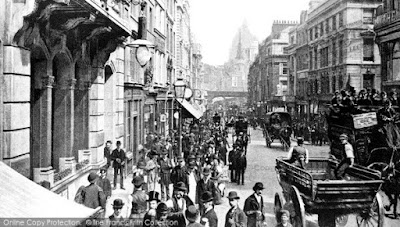
Fleet Street, London, 1890
Figure 1 - Fleet Street, London, 1890. © The Francis Frith Collection.[6]

Morris was ferocious in following this through. The following day’s paper contained an announcement of the judgement, and a threat to continued illegal use of his directory with: “... £10 reward will be paid in each case to the first person who shall give me conclusive information of the fact, by producing proof that they have been canvassed by parties producing cuttings of entries thus illegally taken from the Business Directory [of London] or written copies thereof".[7]

The following year, Morris went after another start-up directory, similarly claiming that they had illegally used material from his directory (Morris v. Wright). A motion was brought by the defendants that the injunction on publication and sale of that directory (The Handbook, or Manufacturer's and Exports' Directory of Great Britain) be dissolved. The defendants had similarly left the employment of Morris as canvassers in spring 1868 and set up as Wright & Co. of Bristol.[8] They had ceased using his directory as soon as the judgement in the Morris v. Ashbee case had been delivered, and claimed that less than 1/8th of their work would have made use of his directory, had it been completed. The court decided that there were clear differences from the prior cases, and that since the new work was unpublished then the question of piracy and could not be determined, and also that there would be no way of compensating for damage if the plaintiff was wrong. The injunction was therefore dissolved.[9] Morris appealed this decision but the appeal was refused with costs.[10]

Repercussions

The four partners filed for bankruptcy on 26 Feb 1869, and they were summoned to the first meeting of the creditors on 15 Mar 1869.[11] They ascribed their failure to the adverse result in the Chancery suit brought against them by Morris. Their debts were £650, of which £351 were due to Morris under the Chancery decree.[12]

William’s wife, Anne, died on 29 Nov 1869 at 30 Smith Terrace, Chelsea, of ‘Asthma, disease of the heart, many years’, aged 68.[13] The informant was John Ashbee (second son) of 324 King’s Road, Chelsea, who was in attendance at that address. Maybe unsurprisingly, given the recent events, the occupation of her husband was given as “retired grocer”.

William died a short time later, on 14 Jan 1870 at 2 York Cottages, Cheltenham, of ‘Disease of the heart’, aged 66.[14] The informant was Thomas Ashbee (eldest son) who was in attendance at the same address. William’s occupation was given as “baker” with no mention of the publishing episode. According to the local newspaper: “…Mr. Ashbee, a baker, living at 2, York Cottages, a native of Tetbury, who died almost instantaneously when sitting in his chair”.[15] It would seem that the case had broken them both, financially and in spirit.

William died intestate and the Grant of Letters of Administration, from 4 Apr 1873, read as follows: “William Ashbee, late of 32 Bouverie Street in the City of London, Publisher, a Widower, who died on 14 January 1870 at 2 Duke's Cottages, Cheltenham in the County of Gloucester, were granted at the Principal Registry … to William Ashbee of 21 Upper Barnsbury Street, Islington in the County of Middlesex, Gentleman the natural and lawful son and one of the Next of Kin. Effects under £100”.[16] The son, also William, is actually their third son. There is some discrepancy over the father’s address — Duke’s Cottages instead of York Cottages — but this is likely to have been some confusion over the Duke of York after whom several places were named in that city. Also, there was no place called Duke’s Cottages.

The astute amongst you must have rightly asked: where is the evidence to show that the baker & grocer is the same man as the publisher? Well, this will cements the whole story. It is clearly for the publisher of Bouverie Street, but also the father of William in Islington whom I can show to have been from Tetbury. Also the date and place of death tally with the death certificate and newspaper report, thus confirming the place of birth, former occupation, and that he was the father of Thomas Ashbee.

High Street, Cheltenham 1901
 Figure 2 - High Street, Cheltenham 1901. © The Francis Frith Collection.[17]

In fact, finding the location of York Cottages proved not to be as simple as I had expected, partly because this was not an official name and partly because the name was used in more than one location. In the 1881 census (piece 2570, folio 81, page 17), York Cottages contained 8 households and was in the vicinity of York St., Dovedale Court, Beauford Cottages, and Gordon Cottages. However, in 1871 (piece 2664, folio 84, page 24), it contained 4 households and was in the vicinity of Grosvenor Terrace, about 0.4 miles S-SW of the other location. These are clearly different but the second one had Thomas Ashbee (William’s eldest son) living at no. 2, and that tallies with the information above. The equivalent place in 1881 was actually just after no. 84 High Street (piece number 2570, folio 55, page 3), and was marked as “York Hotel, in York Passage”. Looking earlier, in 1861, the same place was simply marked simply as “passage” between 83/84 High St. (piece 1797, folio 82, page 11), and occupied by George Taylor, “Inn Keeper”. A very useful Gazetteer of Cheltenham[18] confirms that:

York Passage. Pedestrian passage, now anonymous, leading north from High Street to Grosvenor Terrace. 1780s refs to theatre newly built in York Passage (before visit of George III) (Hart, pp. 134, 141). Still thus in 1896 (Cheltenham Borough Council minutes). Named after the adjacent York Hotel, one of the principal inns in the coaching era, still listed 1800 directory; site now occupied by no. 85 High Street.

It also confirms that the place was alternatively known as Grosvenor Passage. As well as York Passage now being an anonymous thoroughfare, the York Hotel became an Estate Agent’s premises in 1983.[19]

On a brighter note: on 21 Nov 1872, William’s only daughter, Emma Jane Ashbee, married William Stanton of Cheltenham at St Catherine’s Church in that city.[20] These were my g-g-grandparents.

Emma Jane Stanton, née Ashbee, and William Stanton
Figure 3 - Emma Jane Stanton, née Ashbee, and William Stanton.[21]

Analysis

So what is the upshot of those two unusual copyright cases? At the beginning of this article, I indicated that a directory was designed to facilitate access, but it did not stipulate what modes were allowed or disallowed. Had the original been duplicated, or its contents copied in bulk, then the result would have been clear. Had the contents been plundered for some unrelated goal then it might never have come to court. The difference in those cases was that the material was being used in the creation of a rival work or publication — a point emphasised in both judgements — and so it didn’t matter whether the contents were used directly or indirectly.

Even to this day, they are cited in modern texts discussing copyright law. For instance, P. Torremans compares the focus on the “second-comer” in both the Kelly v. Morris and the later Morris v. Ashbee cases, noting that the judgement in both cases found that the arrangement of the original directory had not been taken, which is what we might expect of a copyright infringement, and yet a copyright infringement did take place. He also notes the subsequent cases of Waterlow Publishers Limited v. Rose and Another and Waterlow Directories Ltd v. Reed Information Services Ltd, both concerning more-specialised directories involving information on solicitors.[22]

I think it is debatable whether judgements based largely on effort and expense fall wholly within the original intent of copyright — that being more to do with the copying, reproduction, and republishing of a work. Without their focus on unethical competition then the general implication could stand in the way of progress: something which nearly always benefits from prior work. Maybe they could have been dealt with differently by granting the plaintiff some proportionate recompense from any success of the newer work. However, even a small generalisation away from competition to embrace profiteering from someone else’s effort and expense could have serious consequences, but more on that in a moment.

R. Callmann, writing in the Louisiana Law Review[23], noted that Vice-Chancellor Giffard, who delivered the judgement in Morris v. Ashbee, then delivered a similar but toned down judgement in Pike v. Nicholas, where he stated that “…the correct principle would not prevent defendant from looking into plaintiff's book for direction to the sources of information he desires.” Callmann discusses the inequity and harshness of the rule, and goes on to note that in the later case of Moffatt and Paige v. Gill, the court said: “… you are entitled, taking the [other directory’s] sheets with you, to go and see whether the existing facts concur with the description in the sheets, and if you do that you may publish the result as your own." So what is the specific difference between these cases? Are the rights over a specific work being protected, or the labour and expense incurred by the compiler?

This legal doctrine is better known as sweat of the brow, and in Europe it paved the way for the Databases Directive 96/9/EC that confers certain rights on non-original databases, based on the invested labour and expense rather than any notion of creativity. These rights are distinct from copyright, although they’re both a form of property right. Interestingly, the US rejected this doctrine in the 1991 Supreme Court case Feist Publications v. Rural Telephone Service, although before then it had been upheld in a number of their copyright cases. Under that ruling, mere collections of facts are considered unoriginal and thus not protected by copyright, no matter how much work went into collating them. Although there is pressure to introduce such rights in the US, those who would benefit from the free use of factual information — such as libraries, organisations, and companies — have lobbied against it (note my mention of progress, above). This difference is probably related to the fact that US copyright protection only applies to fixed representations in a tangible medium, whereas for most other nations it applies to any expressed representation of a creative work.

I have previously compared these “second-comer” scenarios to the frequent criticisms of people copying work from the online family trees of others. There are certainly some parallels, but are they enough to conflict with property rights? The production of a family tree does (or should) involve some effort and expense to make the correct parental associations — information which is not directly available from the original sources — and they are effectively published through the medium of the World Wide Web. According to the European viewpoint, anyone copying such data to avoid the same effort and expense, and possibly even using it as guide to accelerate their own compilation, could be violating someone’s property rights. I am not aware of any cases where the ‘sweat of the brow’ doctrine has been applied outside of databases and directories, but where’s the difference? One big difference is that online trees are not commercial publications with any acknowledged financial benefit to their compilers, but should that be important?

In the third and final part of this series, I want to look at the longer-term impact on the Ashbee family, and include some transcriptions of affidavits, depositions, and interrogatories relevant to the Morris v. Ashbee case.


[1] V. C. Gifford's Court: Morris v. Ashbee and Another", The Law Times Reports; Containing All the Cases Argued and Determined in the House of Lords, the Privy Council, the Court of Appeal ..., Volume XIX [19], September 1868 to February 1869 (London: Horace Cox, Strand, 1869): pp.5501.
[2] Ibid. p.551.
[3] "Law Intelligence: Equity Courts - Tuesday: Morris v. Ashbee", Morning Post (11 Nov 1868): p.7, col.3.
[4] "Law Report: Vice-Chancellor's Court, Nov. 10". The Times, issue 26279 (London, Wednesday, 11 Nov 1868): p.11.
[5] Ibid.
[6] London, Fleet Street, 1890. Image © The Francis Frith Collection, ref: L130080 (http://www.francisfrith.com/us/london/london-fleet-street-1890_l130080 : accessed 27 Aug 2015).
[7] "Ten Pounds Reward", The Times, issue 26280 (London, Thursday 12 Nov 1868): p.1,  col.2.
[8] This surname is well-known as a compiler of mercantile directories for England and Wales. I believe this is the J. Wright associated with directories of Bristol and the surrounding area, as opposed to the C. N. Wright associated with directories of the Midlands.
[9] "Law Report: Vice-Chancellors' Courts, Nov. 25", The Times, issue 26605 (London, Friday 26 Nov 1869): p.8.
[10] “Law Report: Court Of Chancery, Lincoln's-Inn, Jan. 14", The Times, issue 26648 (London, Saturday 15 Jan 1870): p.10.
[11] "The Bankruptcy Act 1861: Notice of Adjudications and First Meeting of Creditors", The London Gazette, issue 23475 (2 Mar 1869): p.1488.
[12] “In RE Ashbee and Co.”, London Evening Standard (15 Mar 1869): p.4.
[13] England, death certificate for Anne Ashbee, died 29 Nov 1869; citing 1a/162/345, registered Chelsea 1869/Dec [Q4]; General Register Office (GRO), Southport.
[14] England, death certificate for William Ashbee, died 14 Jan 1870; citing 6a/356/255, registered Cheltenham 1870/Mar [Q1]; GRO.
[15] “Cheltenham: Sudden Deaths”, Birmingham Daily Gazette (18 Jan 1870): p.4.
[16] "Find a will" (beta), gov.uk (https://probatesearch.service.gov.uk/#Wills : purchased 9 Jan 2015), entry for William Ashbee died Cheltenham 14 Jan 1870, PDF downloaded 19 Jan 2015.
[17] High Street, Cheltenham, 1901. Image © The Francis Frith Collection, ref: 47265 (http://www.francisfrith.com/us/cheltenham/cheltenham-high-street-1901_47265 : accessed 27 Aug 2015).
[18] James Hosdon, compiler, "An Historical Gazetteer of Cheltenham", The Bristol & Gloucestershire Archaeological Society (http://www.bgas.org.uk/code/cg_search.php?query=york : queried 23 Aug 2015).
[19] Planning application summary, Cheltenham Borough Council (http://publicaccess.cheltenham.gov.uk/online-applications/applicationDetails.do?activeTab=summary&keyVal=8300329PF : accessed 24 Aug 2015), reference 83/00329/PF.
[20] “Marriages”, Gloucester Journal (23 Nov 1872): p.5.
[21] Photographs copied with the permission of Dorothy Gill, late 1st cousin once removed, from her collection of originals.
[22] Paul Torremans, Copyright Law: A Handbook of Contemporary Research (Edward Elgar Publishing, 1 Jan 2009), pp.1146.
[23] Rudolph Callmann, Copyright and Unfair Competition”, Louisiana Law Review, vol.2, no.4 (May 1940): p.653; online PDF (http://digitalcommons.law.lsu.edu/lalrev/vol2/iss4/5 : accessed 26 Aug 2015).